Many people believe that "tighter is better" when tightening a bolt.
It sounds reasonable—after all, a tighter bolt should hold parts together more securely, right?
In reality, overtightening is one of the most common causes of bolted joint failures.
In this article, we'll explain why overtightening is dangerous and how proper bolt preload creates a reliable joint.
目次
A Bolt Works Like a Spring
One of the biggest misconceptions is that a bolt simply "holds parts together."
In fact, a bolt works like a spring.
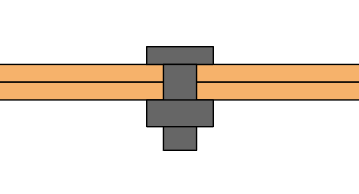
When tightened, the bolt stretches slightly, creating a tensile force known as preload or clamping force.
This preload compresses the connected parts and keeps them firmly together.
The goal of tightening a bolt is not to apply maximum torque, but to achieve the correct preload.
What Happens When You Overtighten a Bolt?
Applying excessive torque increases the preload beyond the bolt's intended design.
This can lead to several problems.
1. Plastic Deformation
Every bolt has an elastic limit.
As long as the bolt stays within this limit, it behaves like a spring and returns to its original length when loosened.
If overtightened, the bolt stretches permanently.
Once this happens:
- Preload becomes unstable
- Fatigue strength decreases
- The bolt is more likely to fail during service
A permanently stretched bolt should never be reused.
2. Bolt Fracture
If tightening continues beyond the yield point, the bolt may eventually break.
This is especially dangerous with:
- High-strength bolts
- Small-diameter bolts
- Stainless steel fasteners
Many bolt failures occur during installation, not during operation.
3. Thread Damage
Excessive tightening places enormous stress on the threads.
Possible failures include:
- Thread stripping
- Nut failure
- Bolt thread damage
- Permanent deformation of the engaged threads
Even if the bolt does not break immediately, damaged threads reduce the reliability of the joint.
4. Damage to the Clamped Parts
The bolt isn't always the weakest component.
Too much preload can damage the materials being clamped.
Examples include:
- Crushed aluminum parts
- Deformed flanges
- Bent brackets
- Damaged plastic components
Sometimes the connected parts fail before the bolt itself.
More Torque Does Not Mean More Safety
Many people assume that increasing torque always makes a joint stronger.
Unfortunately, that's not true.
There is an optimal preload where the joint performs best.
If the preload is too low:
- The joint may loosen.
- Parts may slip.
- Fatigue damage can occur.
If the preload is too high:
- The bolt may yield.
- Threads may fail.
- Components may deform.
The safest joint is achieved by the correct preload—not the highest preload.
Why Torque Isn't the Whole Story
Torque is only an indirect way of controlling preload.
In reality, approximately:
- 90% of the tightening torque is lost to friction.
- Only about 10% actually stretches the bolt.
Friction occurs:
- Under the bolt head
- Under the nut
- Between the threads
Because friction varies with lubrication, surface finish, coatings, and washers, the same tightening torque can produce very different preload values.
That's why engineers often specify:
- Lubrication conditions
- Washer types
- Tightening procedures
- Torque values based on standards
How to Prevent Overtightening
Good bolted joint design follows a few simple rules.
- Use the specified tightening torque.
- Use a calibrated torque wrench.
- Never guess "a little tighter."
- Replace bolts that have yielded.
- Follow the manufacturer's tightening procedure.
For critical applications, engineers may use:
- Torque-angle tightening
- Yield-controlled tightening
- Hydraulic tensioning
- Ultrasonic preload measurement
These methods provide more accurate preload than torque alone.
Key Takeaways
Overtightening does not make a bolted joint stronger.
Instead, it can lead to:
- Plastic deformation
- Bolt fracture
- Thread damage
- Component deformation
- Reduced fatigue life
The purpose of tightening a bolt is to create the correct preload—not to apply maximum force.
Final Thoughts
A well-designed bolted joint depends on proper preload, not excessive torque.
Understanding how bolts behave like springs helps engineers design safer, longer-lasting connections and avoid one of the most common assembly mistakes.
If you're interested in mechanical design, fasteners, and engineering fundamentals, be sure to explore our other articles for practical tips and real-world design knowledge.
If you're interested, feel free to check out my other articles on mechanical design.
